
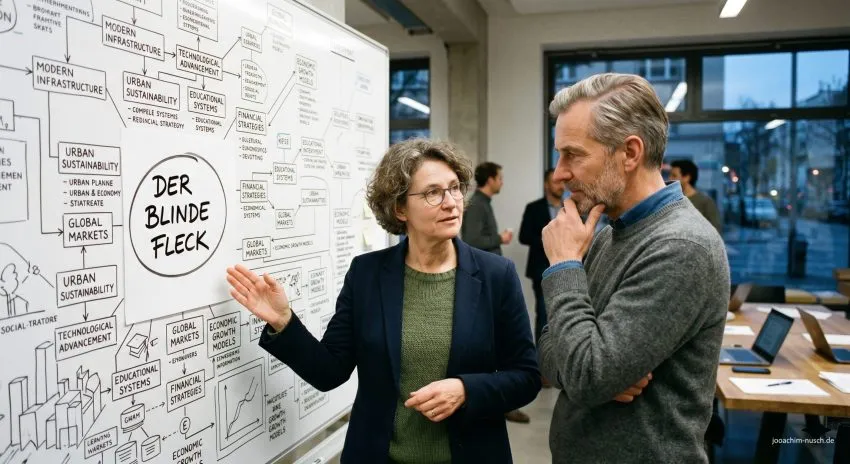
It’s a familiar ritual on the political stage: as soon as the economy falters, the old calls for reform echo across the country. More output, more speed, more competitiveness. Friedrich Merz also repeatedly resorts to this vocabulary – and one senses in it the spirit of an era in which economic growth was almost automatically considered synonymous with social progress.
But perhaps this is precisely where the blind spot of our time lies. For what if the real crisis doesn’t originate first in the factory halls, the government ministries, or the balance sheets – but rather within the individual?
The crisis outside often begins quietly within.
Societies don’t lose their creative power overnight. They gradually become fatigued. Ideas fizzle out, education is administered rather than inspired, and innovation degenerates into a buzzword in Sunday sermons. This rarely has anything to do with taxes, subsidy programs, or bureaucracy alone. Often, it reveals a deeper form of collective exhaustion.
The mindset behind many economic policy debates seems like an echo from the industrial age of the 1970s: if the economy grows, everything else will follow. More production, more investment, more consumption. A linear worldview with clear mechanics.
But humans don’t function like machines.
Today we are experiencing something different: Many people have more opportunities than ever before – and yet feel internally burned out, disoriented, or alienated. The French philosopher Jean Baudrillard already spoke of a society that starves in abundance – not materially, but meaningfully.
Perhaps what we lack most isn’t capital. Perhaps what we lack is attention. Depth. Connection. A culture that understands people not just as a workforce, but as creative beings.
Or, to put it another way:
“The greatest danger to our future is not technology, but humanity, which no longer understands itself.”
Germany needs not only structural reforms – but a reform of consciousness.
Those who focus solely on adjusting the market mechanisms easily overlook the true engine of every society: the human spirit.
When people talk about “convenience” today, there’s perhaps more to it than just an economic criticism. It might also reveal an inner weariness. A society that’s expected to function constantly eventually loses its vitality.
Therefore, discussions about tax policy or working hours alone fall short. Germany needs more than an update to its economic system. It needs a cultural and intellectual upgrade.
A true reform of consciousness does not begin in party programs, but in people’s everyday lives:
- in schools that promote curiosity rather than mere conformity,
- in companies that don’t just conjure up creativity in PowerPoint presentations,
- in a political culture that creates meaning again instead of producing constant stress.
The Indian philosopher Sri Aurobindo once formulated something to the effect that a society only develops further when the consciousness of its people also develops further.
Perhaps this is precisely where the real question for the future of Europe lies.
From mere functioning back to the living human being
Of course, economic stability remains important. No one lives on fine thoughts alone. Prosperity creates freedom, education, security, and opportunities. But as soon as a society values people solely on their productivity, something essential begins to atrophy.
The ancient Greeks already knew that every polis needs more than trade and administration. Aristotle spoke of the good life – not merely the efficient life.
Perhaps our time therefore needs a change of perspective:
- From Having to Being: The success of a society is not only reflected in its gross domestic product, but also in its capacity for compassion, culture, and intellectual maturity.
- Creativity instead of constant administration: Innovation rarely arises under constant pressure. Inspiration needs space to think, breathe, and experiment.
- Leadership with human depth: Good leadership is not limited to columns of figures. It combines intellect with conviction, clarity with humanity.
The sociologist Hartmut Rosa calls this “resonance” – the ability to enter into a genuine relationship with the world again, instead of just rushing through it.
And perhaps therein lies the true reform of our time.
Not faster. Not harder. But more consciously and from a place of stillness. For this, we need methods and approaches that can help us.
Ultimately, the future of a country is not solely determined by the strength of its economy – but by the inner qualities of the people who shape it. Change begins within.
Joachim Nusch